0 £0.00
Reversing Cameras 101
You will see some words/phrases that you might not be familiar with, if the word is coloured green then it means at the very bottom of this page it will have a translation available to explain what it means. What is a reversing camera?A reversing camera is essentially a camera that is installed on the rear of a vehicle to view behind the vehicle when parking. Most reversing cameras can be used all the time to act as a rear view camera too, some even have two cameras built in so that one acts as a rear view camera, and one acts as a reversing/parking camera, these are usually referred to as "twin lens". What are the benefits of fitting a reversing camera?First and foremost is safety.Approximately 25% of all collisions arise from vehicles reversing according to insurance claims data and research by the University of Huddersfield. Despite spending only a short amount of time in reverse gear, it accounts for a lot of the accidents serious enough to make a claim on car insurance.  Secondly, you could save money.Some motorhome insurance companies even give a discount if your vehicle has a reversing camera system installed, it is worth phoning to check. Most importantly, reversing your pride and joy in to someone else's pride and joy, a person, or another object can be very expensive. If you go through the insurance you could face years of increased insurance premiums. It could work out cheaper to fit a reversing camera system to avoid potential costs arising from a reversing collision. Personally I was always used to parking sensors on a vehicle, but after a while you tend to ignore them as they give false alarms about curbs, as well as the constant beep it gives once 12 inches away from the object. My uncle managed to put a nice big dent in the bumper of his BMW X5, slap bang in the middle of his parking sensors. The vehicle supposedly had collision avoidance to avoid this sort of accident (photo below). 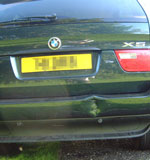 Thirdly, it reduces driver stress when reversing.This is from feedback we have had from our customers, as well as experienced ourselves. When you can physically see that there is nothing behind you, you feel a lot more relaxed when manoeuvring.  Finally, it can save relationships.Well, that might be over selling it slightly, but when you speak to couples who own a large motorhome/caravan, without a camera fitted one person inevitably gets sent out in all weathers, shouting commands that get lost in translation, one less argument on a trip can't hurt, can it? What parts make up a reversing camera setup?The displayThis could be a new display, such as one supplied in our kits, or from our monitors category, or it could be one you already have in your vehicle eg an aftermarket sat nav radio with a reversing camera input (common on most double din Kenwood/Pioneer/Sony etc head units). Please note :- if you have a factory standard display in a car/van then this usually doesn't have universal inputs for reversing cameras, sometimes you can purchase a navigation interface module from elsewhere, but these are very expensive and not available for every model of vehicle. If you choose to have a separate display, as provided in our kits (most common option) you will usually find a wiring harness which combines all the inputs, power/earth/trigger wires in to one cable to the monitor similar to the layout below. You would hide the wiring harness away from sight, usually under the dashboard. 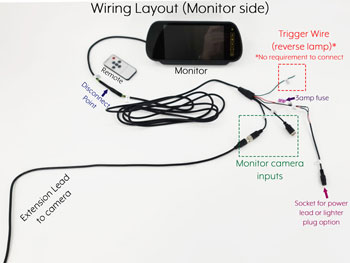 There are usually two main types of monitor sold for reversing cameras, one is the mirror monitor, the other is a dash/surface monitor. The mirror monitor is very popular with motorhomes, cars and vans, whereas the dash/surface monitors are popular for HGV/LGV, buses, motorhomes and vans. The mirror monitor is supplied in our kits with a clip over mirror monitor as standard, however on some of the brake light camera kits we have the option to use another version of the same design monitor with 4 screws on the rear to fit a swan neck bracket, that attaches to the original button found on the windscreen - we only have a small selection of these to fit certain van models. The dash monitors come with either side mounting u brackets, which also accept optional rear brackets, or with rear bracket only. 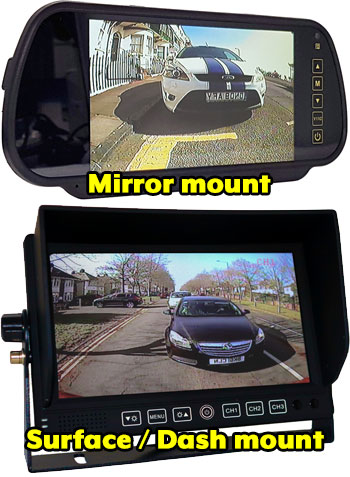 Monitors tend to look very similar to one another due to the use of public design mouldings ie factories by the moulds for cases and they build their own insides to fit in. Rest assured that all of our premium kits use good quality, high performance LCD panels for good picture quality, and are reliable. Last time I checked, we are paying roughly 50% more one some of our models than we could purchase them at, but due to the performance and reliability we are happy to pay this to keep our customers happy, and our reputation in good standing. The cable/extension leadWe usually use a 4 pin locking cable setup on our kits, this allows the monitor to power the camera so that you aren't making extra power connections at the reversing camera end, this means you won't experience CANBUS problems from trying to power cameras from a reverse light supply (you can still trigger the system on/off with the reverse light - as this trigger wire doesn't pull a current to power the camera). This type of cable makes the wiring simple, and trouble free. The 4 pin cable we use is a universal type, we believe in keeping it simple. We have never liked the tactics employed by some branded competitors where they use their own proprietary connectors so that their customers can only ever source spare parts from the original supplier. If you are using an aftermarket head unit then this usually uses a phono/RCA input, it would be up to you if you use 4 pin cable to get to the front and then convert to phono/RCA, or whether you run phono/RCA from the back (this would usually means powering from the reversing light). 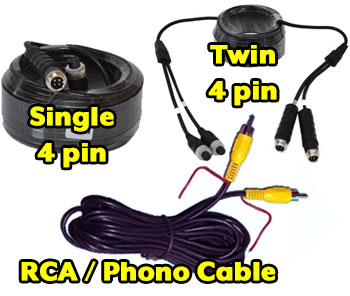 The cameraThe most important part! this camera will be your eyes at the back of your vehicle. The cameras will have a mirror image view, this is to make it replicate what you would usually expect to see in both your interior mirrors and your side mirrors. We often get people ask why the reversing camera should be mirror imaged and not normal view, this is because if you had a normal view camera looking backwards, if someone was to overtake you the car would go to the left of the camera, but you wouldn't want this going to the left side of the monitor as this would look like someone was undertaking you. 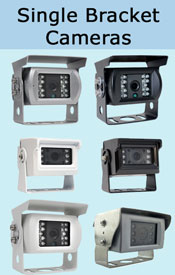 Single bracket cameras are a very popular option due to the flexibility of mounting, and their size means they can fit a decent sensor/chip combination for a good picture. Usually have an array of IR LED's for a good night vision, and most of our bracket cameras come with a painted stainless steel bracket to avoid rust. Bracket cameras can be mounted on both horizontal surfaces and vertical surfaces. Most often fitted high up to give a birdseye view when parking. 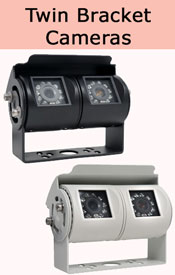 Twin bracket cameras are most popular with motorhomes, the system goes from being useful only when in reverse, to being useful all the time you are driving. Usually mounted on the rear wall of the vehicle, with one lens pointed down at the floor as the parking camera, and the other lens looking down the road as the rear view camera. Both cameras have different lenses, as they do different jobs. The one looking down the road is more narrow angle, as this helps you determine the distance of following vehicles. The camera looking downwards for parking is more wide angle, to allow the maximum coverage at a close range. Again most often fitted high up to give a birdseye view when parking. 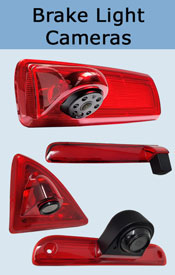 Brake Light cameras have become increasingly popular for panel van owners, including motorhome based on panel van conversions. They replace the existing brake light with a new brake light with a built in camera. These look almost like they were fitted at the factory. 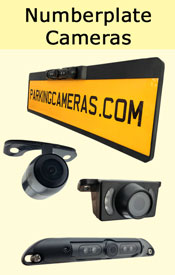 Numberplate cameras are a selection of small cameras that are traditionally fitted around the numberplate area. Ideal for cars and vans. 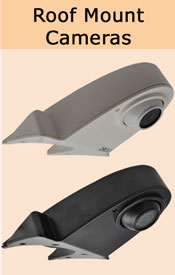 Roof mount cameras are mounted on the top of the roof with a plastic overhang that houses a ball camera to look down from a birdseye view. 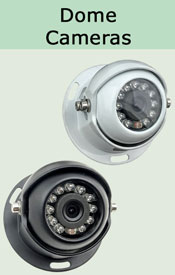 Dome cameras are a subtle surface mounted camera, most popular for motorhome owners. 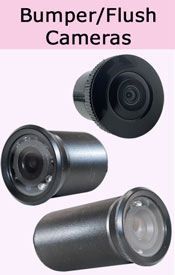 Bumper cameras come supplied with a hole saw to drill the correct sized hole for the camera to fix into, typically mounted in the bumper - although can be mounted in anywhere that has a spare surface the correct size. Very popular in cars, vans, and motorhomes. Can I use my camera like a rear view mirror?Absolutely, all of our premium kits can be left on all the time, we do have some models eg single brake light cameras/roof cameras that have limited adjustability to look back down the road. The ultimate rear view camera kits are our twin lens cameras, we carry twin lens bracket cameras, a twin lens roof camera, and some models of brake light camera with twin lens. The twin lens cameras are essentially two cameras in one mounting, one camera tends to be more narrow angle - this is used for rear view, the second camera is wider angle - for parking. I have noticed a lot of image sensor specifications on the cameras, how do I decide which one to go for?The image sensor is the part of a camera that turns the picture that the lens picks up in to an image to be transmitted, so the better quality image sensor, the better the picture quality. This used to be much less complicated in the past, in the past it was as simple as CCD is good, CMOS isn't. Recently there has been a big improvement in CMOS sensors, with lots of high end sensors coming on to the marketplace notably the PC1058 and the PC4089, which we use on some of our premium CMOS cameras. We still stock some of the cheaper budget CMOS cameras, and the picture quality isn't as good as the premium ones mentioned. Of course CCD sensors still reign supreme in our opinion, the two best sensors are the Sony 811 700TVL 1/3" CCD, and the Sharp 600TVL 1/3" CCD. If you are buying a complete kit, rest assured that we will have only used the better image sensor cameras as part of that kit. See our personal ratings amongst the popular image sensors below: 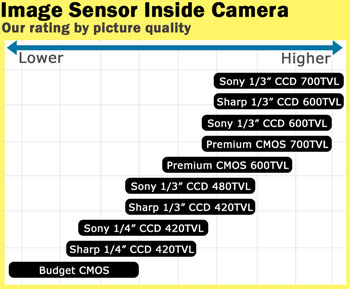 What about wireless, would you recommend this for use as a reversing camera?In some circumstances we would. Let me start off by saying, although the picture quality on wireless has increased massively recently due to digital wireless, it still won't beat what can be achieved through a cable, so if you want the ultimate picture quality then cabled would always be the better option. The main consideration to factor in, is whether you can find a non-CANBUS protected ignition based power supply near the camera, CANBUS is a protective system on modern vehicles that looks for unusual current draws, and cuts power if it detects anything. Older vehicles may have light systems to tap off that don't have CANBUS, but most modern vehicles built in the last several years have CANBUS, and it's been around before this too so it's worth checking if yours has. The wireless cameras use around 4.5W of power (almost the same as a reversing light bulb), so if the wire to the reversing light suddenly starts pulling 9.5W instead of the expected 5W CANBUS will think something has gone wrong and cut the power to the light/camera. If you have a caravan or a trailer then you don't have to worry about this, as trailer electrics aren't CANBUS controlled, so in these instances we do recommend wireless systems, although a lot of people end up running them all the time as rear view camera systems. Jargon BusterCANBUS Controller Area Network BUS, this has become standard on most vehicles today, one of its functions is to keep an eye out for faults, this can have an impact if you were to try using the reverse light power supply to feed a camera directly ie not supplied with power from the monitor (as our premium cabled kits do). CANBUS can sometimes see an unusual draw of power at the rear lights and its response is usually to cut the supply to the affected light in order to protect the safety of the system. Most of the time you would only see this with a higher power drain suchas wireless cameras, wireless tends to use 4.5W of power, your bulbs are usually 5W - so almost double what CANBUS expects to see. Non-wireless cameras use a lot less, but there is still a risk, one workaround is a relay, but we recommend either using our complete kit where the monitor sends power to the camera, or if you are using your own screen then simply run an ignition based power supply back to the camera (the 4 pin cable with a CAB0020 adaptor would be the easiest to do this). CCD Charge-coupled device, put simply this is another type of technology used to capture colour/light data to convert to a signal. CCD sensors have always been our preference for our premium systems, they traditionally have a higher picture quality, they do cost more to produce, but the results are very good. The larger 1/3" CCD sensors have better performance than the smaller 1/4" versions. CCD sensors use a special manufacturing process to create the ability to transport charge across the chip without distortion, this results in very high quality sensors in terms of fidelity and light sensitivity. CMOS Complementary Metal Oxide Semiconductor, put simply this is just the type of technology used to capture the colour/light data to convert to a signal. CMOS traditionally has been a poorer picture quality than its competition (CCD - see below). The manufacturers have recently improved the technology greatly, the benefit of CMOS has always been the lower cost. There is a huge array of CMOS qualities from very cheap and cheerful budget ranges, to the very high quality ranges. In our premium cameras/kits we would only ever use the higher spec versions. Digital Wireless A type of technology that superseded the original analogue wireless signal. Older analogue wireless had a terrible reputation in Europe due to the transmission power limits imposed across the UK and Europe of just 10mW, this used to struggle with cars sometimes, and we also had many reports of people driving along and picking up peoples house CCTV and other vehicles feeds. Digital wireless, as the name suggests, turns the signal in to a digital feed, almost like a stream. It is encoded in MP4, which some of you might recognise as a codec for video - simply put it is turned in to an efficient digital picture that allows the maximum frame rate possible when sent over distance. The signal is also encrypted between the two boxes, this means your digital wireless equipment will ignore anything else on the same frequency apart from the feed coming from the equipment it is paired securely with, no longer will you be driving along and suddenly see a babies face being transmitted on a nannycam! Image sensor The part of the camera that sits underneath the lens of the camera, this part is responsible for capturing light and colour to turn in to a signal for the monitor to display. Navigation interface module A box that can be plugged in to a standard factory navigation screens wiring, the box accepts a reversing camera input, and when you enter reverse it takes over the screen to display the picture from the camera, reverting back when reverse is no longer engaged. Phono/RCA This is a type of cable that has been around for a long time, you may recognise it on DVD players and TV's before the takeover of HDMI leads. Traditionally they have a yellow plug and socket, the plug has just a single pin, however we have seen a whole host of colours, as the leads all function in the same way. |