0 £0.00
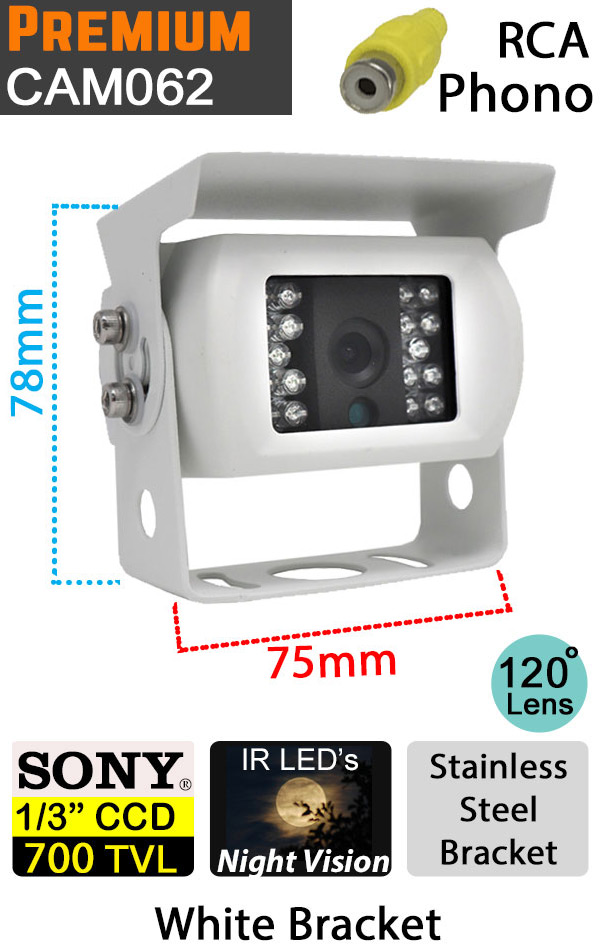
White Reversing Camera | Sony CCD | RCA Phono connector | Stainless Steel bracket | CAM062
Category: Home
Description
CAM062 - White stainless steel bracket reversing camera with RCA/Phono connectors
Anti-Corrosion Stainless Steel Camera BracketThe camera has a stainless steel bracket, which is shown to last a very long time without corrosion, unlike mild steel we have seen from most other retailers, which tends to rust in a matter of a few months.  Image Sensor for CameraAn image sensor is the part of the camera that detects and captures information to make an image, there are various sizes of sensor usually between 1/4" and 1/3" with the larger sensors able to capture more detail. In the old days, you used to have to pick CCD for quality as CMOS wasn't as good, this has changed recently with some advancements in CMOS technology (there are varying quality levels of CMOS to confuse matters). In this particular kit, we are using the Sony 1/3" CCD 700TVL image sensor inside the camera. We consider this the joint best image sensor in terms of picture quality you can get on a reversing camera. 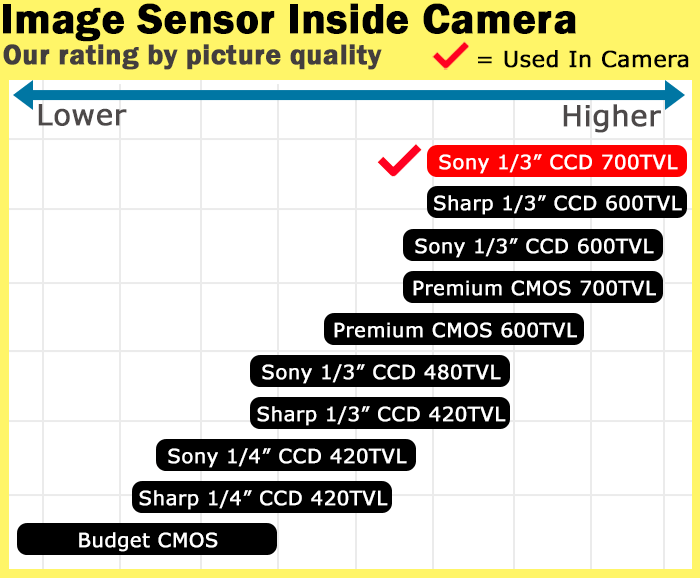 |
Detailed Images
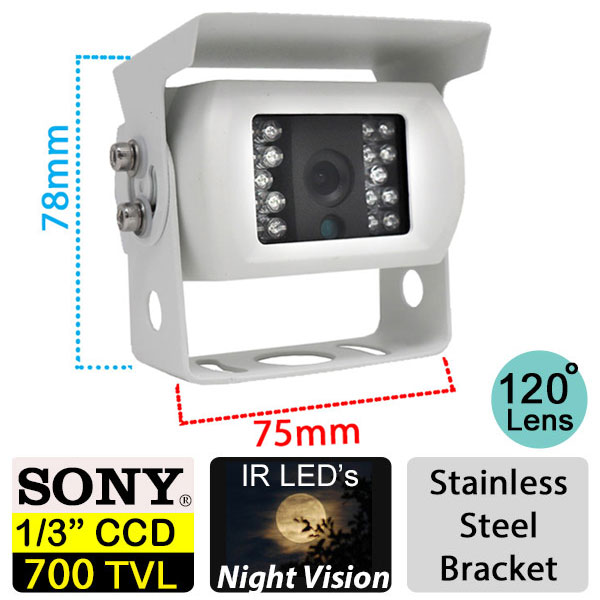
White bracket Sony CCD reversing camera
| Image Sensor :1/3 SONY CCD 960H 700TVL |
Customers Also Bought

Waeco / Dometic / Baileys / Burstner Motorhome Pre-fitted Cable compatible adaptors 2010+ to Single 4 pin | CAB00W
CAB00W
£18.00
VAT Included
£3.00 
M / M Male to Male Phono Coupler Adaptor to convert a Female/Socket to a Male/Plug | ACC091
ACC091
£0.75
VAT Included
£0.13 
Camera bundle compatible with Elddis motorhomes to replace an AW9307 camera with 4 pin push fit
Elddis Bundle (push fit)
£84.00
VAT Included
£14.00